What a Real Day Looks Like During Fire Season
People who have never worked a wildland fire assignment tend to imagine a single dramatic scene: flames roaring through timber, crews sprinting uphill, helicopters circling overhead. That image is not wrong, but it represents maybe ten percent of what a contract wildland firefighter actually does. The other ninety percent is preparation, communication, travel, maintenance, and disciplined routine.
Here is an honest walkthrough of a typical day during fire season — covering both initial attack assignments and large-fire deployments.
0500–0600: The Day Starts Early
Your alarm goes off before the sun is up. On an initial attack (IA) assignment, you are up by 0500. On a large fire at an incident base camp, most shifts start with a 0600 briefing.
You dress in Nomex, lace your fire boots, and grab your PPE. Breakfast happens fast — at camp, the caterer has a chow line running. On an IA assignment, you are eating whatever you packed.
Every firefighter checks the same essentials before leaving the rack: fire shelter, headlamp, water, personal gear bag. There is no running back for anything once you are on the fireline.
0600–0700: Morning Briefing and Equipment Checks
The morning operational briefing is the most important meeting of the day. On a large fire, this happens at the Incident Command Post and covers:
- Weather forecast — wind speed, direction, relative humidity, and temperature projections
- Fire behavior predictions — where the fire is expected to move and how aggressively
- Division assignments — where your engine or crew is deploying on the fire perimeter
- Safety hazards — snags, rolling material, air operations, road closures
- Communications plan — radio frequencies, check-in protocols
After briefing, you head to your engine. At Ponderosa Fire, our Type 6 and Type 3 engines are maintained to high standards, but every morning you run through a pre-trip inspection. Fluid levels, tire pressure, pump operation, hose loads, nozzles, hand tools, chainsaw function, medical kit. Nothing leaves the yard without a complete check.
The morning equipment check is not busywork. On the fireline, a failed pump or a missing tool can put people at risk. You check everything, every time.
0700–0900: Travel to Assignment
On an IA assignment, you might be staged at a local BLM or USFS facility, waiting for dispatch. The call comes over the radio and you are rolling within minutes, sometimes fifteen minutes down a highway, sometimes two hours on forest roads to reach a remote smoke report.
On a large fire, travel from camp to your assigned division can take over an hour. You are navigating one-lane forest roads, dodging falling snags, and coordinating with other resources. Situational awareness matters. You are scanning the terrain, reading the smoke, and mentally preparing for what you are about to encounter.
0900–1700: Fireline Operations
This is the core of the day. What you do depends entirely on the assignment:
-
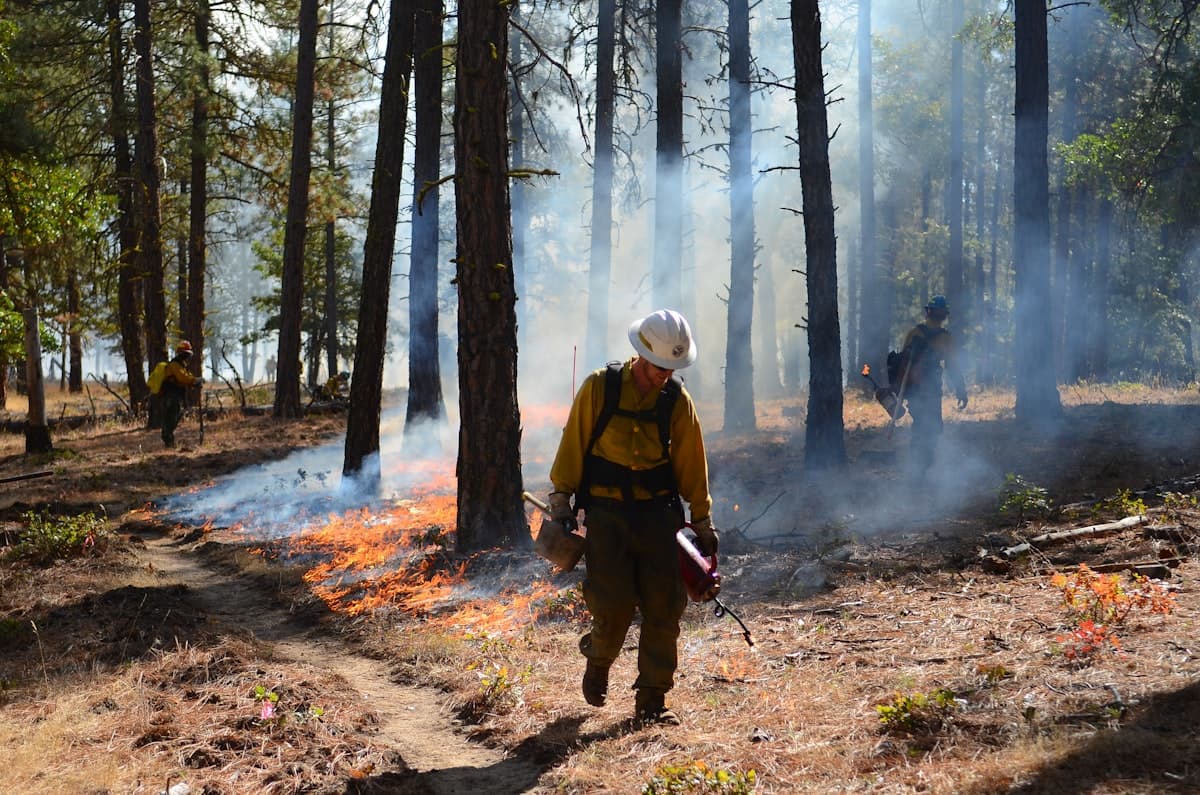
Initial attack: You arrive at a new fire start — maybe a lightning strike in sagebrush or a spot fire in timber. Your crew pulls hose, builds handline, cuts fireline around the perimeter, and puts water on the active edge. IA work is fast, physical, and often decisive. A well-trained engine crew can stop a fire at a quarter acre that would have become a thousand-acre incident by afternoon.
-
Structure protection: You stage near homes or infrastructure in the fire's path, clearing defensible space, setting up sprinklers, and preparing for the fire front to arrive.
-
Mop-up and patrol: After the active fire is controlled, you work the perimeter, extinguishing hot spots, turning over duff and debris, and ensuring nothing crosses the containment line.
-
Division support on a large fire: Your engine is assigned to a specific section of the fire perimeter. You may be holding a road as a fuel break, supporting hand crews with water, or working in tandem with bulldozers to establish control lines.
The physical demands are significant. You are hiking over uneven terrain with tools, pulling hose uphill, swinging a Pulaski, and operating in heat and smoke. Hydration is critical. Meals are MREs or sack lunches eaten on the fireline between assignments.
Communication is constant. You are checking in with your division supervisor, monitoring radio traffic for safety updates, and coordinating with other engines and crews nearby. The NWCG qualification system ensures everyone on the fireline speaks the same operational language.
1700–1900: Transition and Demobilization
As the operational period winds down, the incoming shift takes over or you begin securing your position. You may be released back to camp or to your staging area. The drive back involves the same hazard awareness as the morning — fatigue is a real factor by this point.
Back at camp or the station, you immediately begin post-shift maintenance:
- Refuel the engine and restock water
- Reload hose and replace any damaged equipment
- Clean and sharpen hand tools
- Restock personal supplies — water, food, batteries
- Complete daily paperwork — crew time reports, equipment usage logs, incident documentation
At Ponderosa Fire, our engine bosses take equipment maintenance seriously. The fleet has to be ready to roll at a moment's notice. A crew that neglects post-shift maintenance is a crew that starts the next day behind.
1900–2100: Camp Life and Recovery
On a large fire assignment, evenings at base camp follow a predictable rhythm. You hit the chow line, eat a hot meal, and take care of personal needs — shower if the facilities are available, phone call home, laundry if you can manage it.
Camp life has its own culture. You are sharing space with hundreds of other firefighters from federal agencies, contract companies, and out-of-state resources. The conversations around the chow tent are where you pick up techniques from experienced operators and build professional relationships that last for years.
By 2100, most crews are in their tents. Managing fatigue is not optional.
The Difference at a Private Contractor
Working for a private wildland fire contractor like Ponderosa Fire offers a different daily experience than federal employment in some key ways. Our crews are smaller, so you get more direct leadership and mentorship. Equipment decisions are made by operators, not committees. And when you are dispatched, you are working alongside people who chose this work because they are passionate about it.
If this sounds like the kind of day that appeals to you — physical, purposeful, team-oriented, and never the same twice — we want to hear from you. Visit our careers page to learn about current openings, or apply directly to start the conversation.
Ready to See It for Yourself?
Ponderosa Fire LLC is always looking for motivated, qualified individuals ready to do meaningful work during fire season. Check our open positions and take the first step toward a career on the fireline.